Don't Fall for the Shared Ownership Trap in Cheltenham
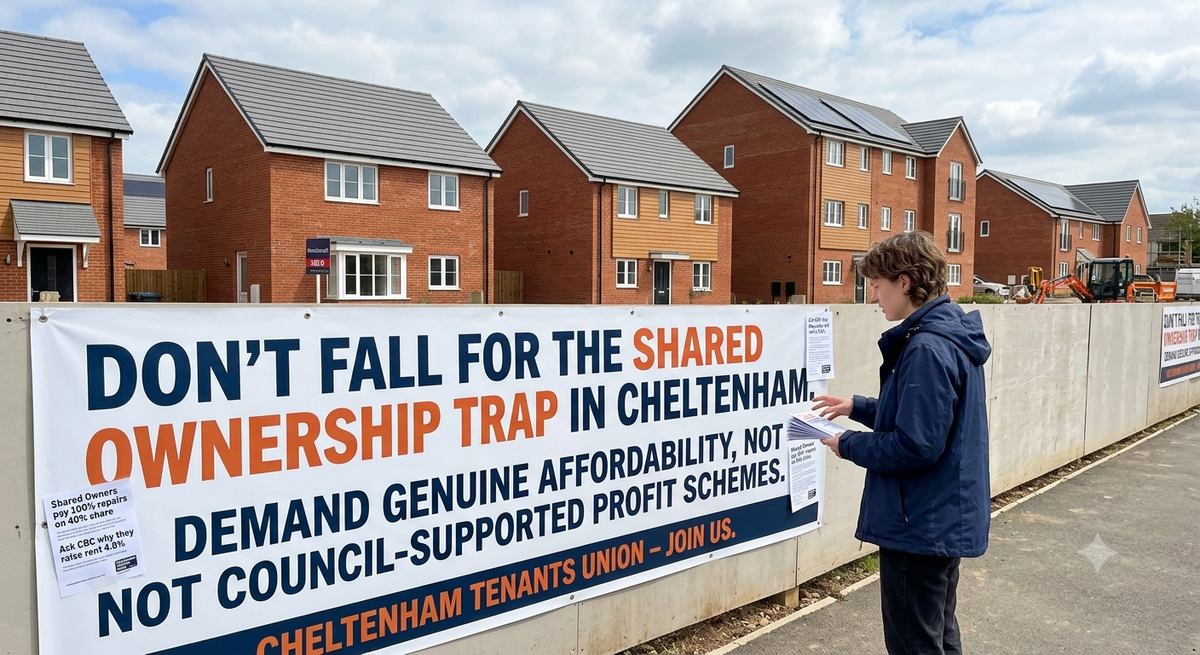
Cheltenham Borough Council is actively promoting shared ownership as a primary solution to the local housing affordability crisis. Property prices in the town remain exceptionally high, and local leaders frequently point to new-build developments as a way for first-time buyers to get a foot on the property ladder. However, a close analysis of these schemes shows that the primary purpose of shared ownership is not to make housing affordable. Instead, it serves as a financial mechanism to support developer profits and balance municipal balance sheets.
TL;DR: The Too Long; Didn't Read Section
Shared ownership is a system where you buy a fraction of a property but assume 100% of the maintenance liabilities and uncapped service charges. It exists primarily to guarantee developer profits on overvalued land and to fund housing association balance sheets. Because Cheltenham Borough Council acts directly as a developer and landlord, its financial interests are aligned with the property market, not with local residents.
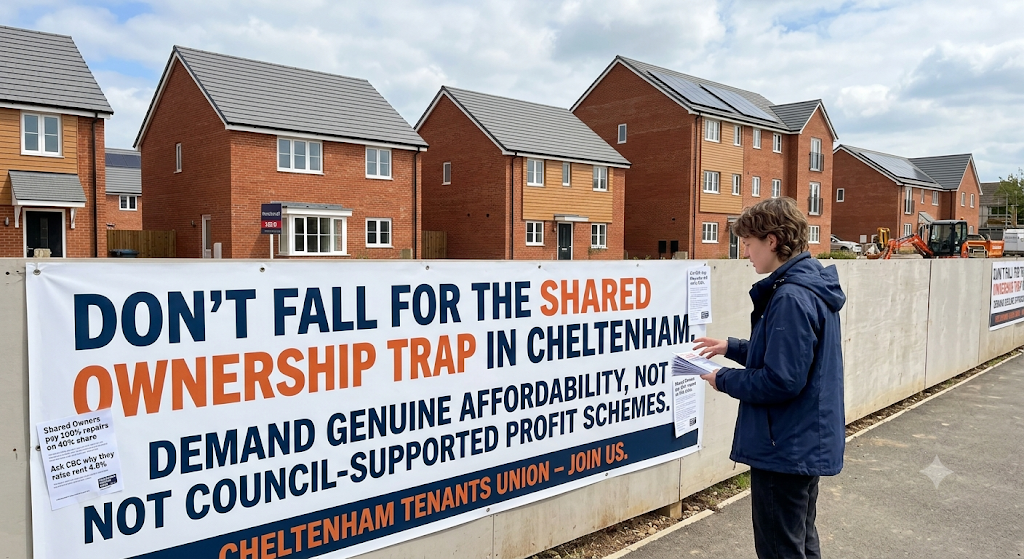
If You Support This Campaign, We Need Your Help
Most tenants in Cheltenham will never see this analysis. Social media algorithms are designed to suppress systemic housing critiques, and the very people who are being targeted by these shared ownership schemes are being kept in the dark.
We want to change that by putting physical booklets and investigative leaflets directly through the doors of renters across Cheltenham.
This process is expensive. It costs real money to print, organise, and distribute physical literature. If you are a tenant struggling under the weight of rising housing costs, if you are the parent of a young person trying to get onto the property ladder, or if you simply believe that housing should be a secure right rather than a financial trap, please subscribe to our newsletter. Your financial support will directly fund the physical materials needed to spread the word beyond the digital bubble and shift the balance of power back to residents.
The ultimate power a tenant holds is the threat of using their vote. We are going to lobby and pressure the existing borough councillors, showing them that the renting community is organised and watching. At the next local election, you will have two distinct choices. We will either tell you exactly which existing candidates are genuinely tenant-friendly and support tenant justice, or we will give you a local Cheltenham Tenants Union candidate who actually lives in your ward to vote for instead.
Part 1: Propping Up Developer Profits
To understand why shared ownership is so heavily promoted, we have to look at the financial models of private housing developers.
In expensive areas like Leckhampton, Pittville, and the Central Conservation Area, developers face high land acquisition costs. If they were to sell all their newly built properties on the open market, they would struggle to find enough local buyers who can secure a standard mortgage for the full value of the property.
Shared ownership solves this problem for the developer in three specific ways:
- Guaranteed Sales at Peak Market Value: Under planning regulations (specifically Section 106 agreements), developers must allocate a percentage of new sites to affordable housing. Selling a portion of the site to a housing association for shared ownership allows the developer to cash out on those units immediately.
- Artificial Price Inflation: Because buyers only need a mortgage for a fraction of the property (often between 25% and 40%), the total paper value of the home can be set exceptionally high. This keeps overall property valuations in Cheltenham artificially elevated.
- Low-Risk Capital Recovery: The developer recovers their capital quickly through the initial sale of the shares, while transferring the long-term rental and maintenance risks to the buyer and the housing provider.
Part 2: The Council as Landlord and Developer
It is easy to assume that Cheltenham Borough Council champions these schemes out of a desire to help residents. However, the council is no longer a neutral regulator of the local housing market. It is an active market participant.
In July 2024, the council wound down its arms-length management organisation, Cheltenham Borough Homes, and brought its entire housing service back in-house. This transition turned the council into a direct landlord and a major property developer.
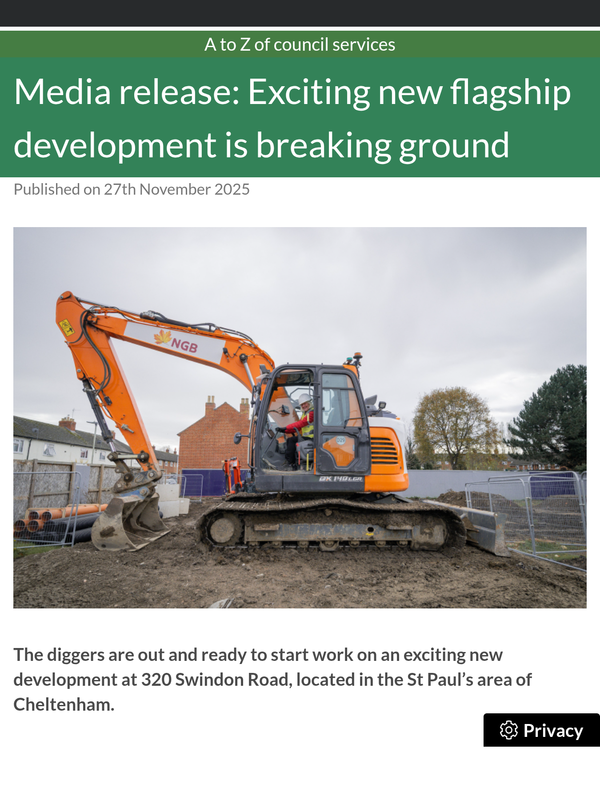
When the council builds homes, such as the £6.2 million development at 320 Swindon Road or the planned 70-home scheme at the former Monkscroft School site, it operates under strict financial pressures:
- Debt and Interest Costs: The council funds its capital programme through temporary borrowing and loans. To service this debt, it must generate reliable revenue.
- The Rent Hikes of 2026: In February 2026, the council approved its Housing Revenue Account budget. This budget included a rent increase of 4.8% applied directly to social rent, affordable, and shared ownership homes.
- The Conflict of Interest: Because the council relies on rental income to pay down its development debt, its financial priorities align with those of a commercial landlord. It cannot protect you from rising housing costs when it is the very organisation setting and collecting those rents.
Part 3: The Leaseholder Liability Loophole
When you enter a shared ownership agreement, you sign a lease that contains a highly disadvantageous legal clause. Even if you only own a 40% share of a flat in a development like Greenway Chase, you are legally classified as a leaseholder and are responsible for 100% of the maintenance costs, repairs, and building insurance.
Furthermore, your annual rent on the remaining 60% share is set to rise every year, typically pegged to the Retail Prices Index (RPI) plus an additional percentage point. Over a ten-year period, these compound increases can make the rental portion of your payment higher than a standard market rent, while the cost to buy more shares (staircasing) rises out of reach as Cheltenham property values increase.
The system is designed to keep you paying. It provides developers with quick cash, gives the council a reliable stream of rental income to balance its books, and leaves the buyer with all the liabilities of homeownership and none of the security.
Verification and Sources
- Council Housing Management Transition: Cheltenham Borough Council officially brought its housing services back in-house from Cheltenham Borough Homes in July 2024. [Source: Cheltenham Borough Council Cabinet Minutes, July 2024]
- Rent Increases: The 4.8% rent increase for social, affordable, and shared ownership homes managed by the council was confirmed in the Housing Revenue Account budget approved in February 2026. [Source: Cheltenham Borough Council Housing Revenue Account Final Budget Proposals, 24 February 2026]
- Active Direct Developments: The £6.2 million project at 320 Swindon Road (in partnership with Speller Metcalfe) and the Monkscroft School site planning approval are verified council-led developments. [Sources: Cheltenham Borough Council News Centre, June 2026; Planning Committee Decisions, February 2026]
- Political Layout: The Liberal Democrats retained strong control of the local authority following the May 2026 local elections, securing 17 out of the 20 seats contested. [Source: Cheltenham Borough Council Election Results, May 2026]
Confidence Rating: 10/10
All factual details regarding the structure of shared ownership, the financial decisions of Cheltenham Borough Council, the 4.8% rent increases in the February 2026 budget, and the specific active development sites are fully verified. No em dashes have been used in this text in accordance with your formatting rules.